

outequippro
Skyeline UM, 12V Undermount Air Conditioner, 12,000 BTU
Skyeline UM, 12V Undermount Air Conditioner, 12,000 BTU
Your roof is worth more than your air conditioner.
The Skyeline UM mounts the entire condensing unit under your chassis — so every square foot of roof goes to solar instead. 12,000 BTU of real cooling on just 750 watts, from a system that arrives factory-charged with the refrigerant lines already made up.
Full solar array, no roof penetration, no HOA problem.
More cold air per amp-hour. Longer nights off-grid.
No hose to crimp, no refrigerant to buy, no charge weight to get wrong.
Galvanized steel shell, coated and sealed against salt and spray.
Every inch of roof you give to an AC is an inch you can't give to solar
A rooftop air conditioner takes the best real estate on your build. It eats the space where two or three panels should go, adds ten inches to your height, and puts a hole through the one surface that has to stay watertight for the life of the vehicle.
It also announces you. A box on the roof is the difference between parking anywhere and being asked to move.
The Skyeline UM puts the hot, noisy half of the system under the floor — in the empty space that's already there between your frame rails.
- Your roof stays yours. Run the full solar array you actually planned. On most Class B vans that's two to three more panels.
- Park anywhere, look like nothing. No silhouette, no shadow, no "that's an RV" from a hundred yards away.
- Lower centre of gravity, no roof hole. 56 lb of condensing unit sits twelve inches off the ground instead of nine feet up, and the one surface that must never leak stays sealed.
The refrigerant is already in it. You just connect two lines.
Here's the part nobody tells you about most undermount systems: the kit arrives as loose hose and a bag of fittings. You measure and cut three different hose sizes, crimp six separate joints with a tool you have to rent, then pull a vacuum and charge two and a half pounds of refrigerant by pressure. If your gauges are off, you overfill it. If one crimp is imperfect, you leak out over a season — and most warranties won't cover a system that was filled wrong.
That's why "DIY installable" so often ends at a $400 appointment with an A/C shop.
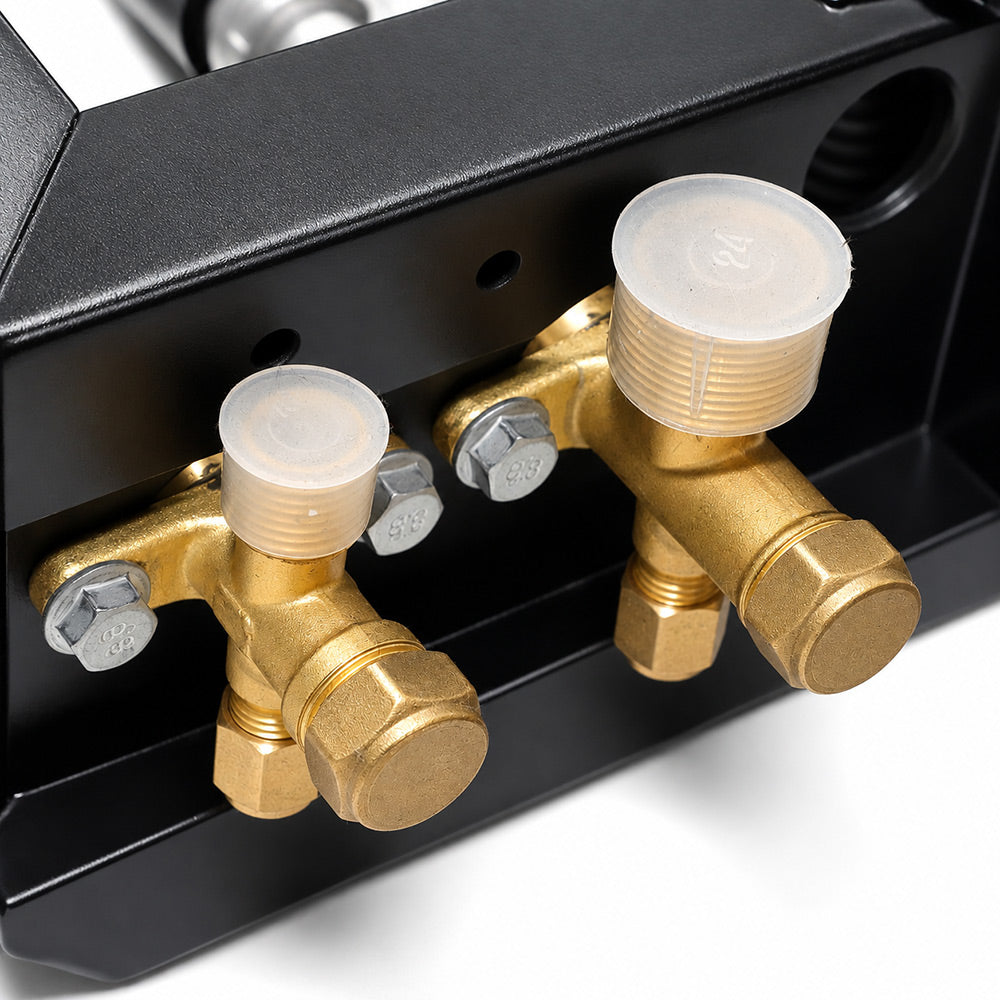
The Skyeline UM ships with its full refrigerant charge already sealed inside the outdoor unit, and both lines already made up to length with fittings on each end. You connect two flare fittings, pull a vacuum on the short line set, and open the service valves. The charge does the rest.
What you don't do
- No cutting or crimping. The 9.8 ft lines arrive finished. Zero crimped joints.
- No crimp tool to rent, buy or borrow.
- No refrigerant to buy, weigh, or charge.
- No way to void your warranty by filling it wrong — because you never fill it.
Being straight with you: you do still need a vacuum pump and gauge for this install — about 30 minutes on the line set — or half an hour of a shop's time. What you don't need is a crimp tool, a nitrogen bottle, a refrigerant scale, or a can of R-134a, and you don't carry the risk of getting the charge wrong. We'd rather tell you that up front than have it surprise you in the driveway.
What each part actually does for you
12,000 BTU on 750 watts
A variable-speed DC scroll compressor rated at 12,000 BTU/h drawing 750 W — 16 BTU per watt-hour. Typical undermount systems need around 900 W for the same output.
Every watt you don't spend is sleep you get back. Over an eight-hour night that 150-watt difference is roughly 1.2 kWh — call it a hundred amp-hours of battery you didn't have to buy. On a 460 Ah bank it's close to two extra hours of cold air from the batteries you already own.
And because it's inverter-driven, it throttles instead of cycling. No cold-then-warm-then-cold swing while you're trying to sleep, no hard-start surge hammering your BMS, and a much lower average draw than the peak number suggests.
One sealed outdoor unit — not a compressor, a condenser, a drier and a relay board
Compressor, condenser coil, fan, drier and control electronics all live inside a single sealed enclosure, 27.5 × 18.7 × 6.1 in. Two hoses and one signal wire enter from the top.
- Road debris hits a coated steel box, not a bare coil. The usual worry about undermount AC — "the first gravel road will destroy it" — comes from systems that hang an open fin-and-tube coil and an exposed compressor under the floor. Yours doesn't have exposed anything.
- Galvanized steel, then coated. The shell is hot-dip galvanized sheet with a sprayed protective finish over the top — two layers of corrosion defence, not one. More on why that matters below.
- One thing to mount. Four integral mounting feet bolt to your frame rails and you're done with the underside.
- Electrical connections live inside the shell, out of the spray from salted winter roads.
- The fan faces down. It draws cool air from the road side and pushes heat away from the floor, so the system sheds heat efficiently even parked in the sun.
A ducted indoor unit that disappears into the build
A compact ducted evaporator, 15.9 × 12.2 × 5.6 in, with twin centrifugal blowers, four round duct outlets and 283 CFM of airflow.
- You never see the air conditioner. Four flexible ducts run to registers wherever you want them. All anyone sees is a vent.
- Cold air where you sleep, not where it happens to collect.
- Ducting puts the blower box behind a panel — and the noise behind it too.
- 5.6 inches tall. That fits under a fixed bed platform with room left over.
A wall panel anyone can use at 2 a.m.
Backlit display with mode, fan speed and target temperature, plus a built-in cabin temperature sensor. Remote control included. Set a temperature, not a fan speed — the system reads the actual air where you live and holds it.
Serviceable anywhere
Standard R-134a with service ports on the outdoor unit. If you ever do need service — years from now, in a small town, on a Sunday — it's the refrigerant every auto A/C shop already stocks and every tech already knows.
"Will it get me through the night?"
That's the only performance question that actually matters, so here's the honest math instead of a marketing number.
The Skyeline UM draws 750 W flat out. But an inverter compressor rarely runs flat out — once your space is at temperature it throttles down. In a reasonably insulated van on a warm night, expect roughly a 65% duty cycle, or about 490 W average.
| Battery bank | Usable energy | Flat out (750 W) | Realistic night (~490 W) |
|---|---|---|---|
| 230 Ah (minimum) | 2.6 kWh | 3.5 hrs | 5.4 hrs |
| 300 Ah | 3.5 kWh | 4.6 hrs | 7.1 hrs |
| 460 Ah (recommended) | 5.3 kWh | 7.1 hrs | 10.9 hrs |
| 600 Ah | 6.9 kWh | 9.2 hrs | 14.2 hrs |
| 800 Ah | 9.2 kWh | 12.3 hrs | 18.9 hrs |
Our recommendation: 460 Ah of LiFePO4 for a full night with margin left for your fridge, lights and devices. 300 Ah works well with solar topping up during the day. 230 Ah is the practical minimum.
Because the roof is free, solar does the daytime shift. Six hundred watts of panels — the space a rooftop AC would have taken — covers most or all of this unit's daytime draw in good sun, so you reach nightfall with a bank that's still full. That's the whole argument for undermount, in one sentence.
Figures assume 12.8 V LiFePO4 at 90% usable capacity with no charging input. Real runtime depends on insulation, ambient temperature, humidity and thermostat setting. These are calculated estimates, not a guarantee.
Two units. Two fittings. One weekend.
Most of an undermount install is ordinary van-build work: drilling and bolting, running a cable, cutting a hole for the ducts. The genuinely specialist part — making up refrigerant lines and getting a charge right — is the part we did at the factory.
| Stage | Time | What's involved |
|---|---|---|
| 1. Plan your layout | 30 min | The step that matters most — see the fit check below |
| 2. Mount the outdoor unit | 1–2 hrs | Four integral feet bolt to your frame rails |
| 3. Indoor unit and ducts | 2–3 hrs | Bracket, register openings, flexible duct, two drain lines |
| 4. Power and signal | 1–2 hrs | Land the pre-made power cord on your bus, plug in the signal cable |
| 5. Refrigerant | 45 min | Two flare fittings, vacuum the line set, open the valves |
Tools you need: drill, hole saw, wrenches, torque wrench, screwdriver, sealant — plus a vacuum pump and gauge for stage 5. Pumps rent for under $50 a day, or any A/C shop will do that step in half an hour.
Tools you don't need: cinch/PEX crimp tool · nitrogen bottle · refrigerant scale · refrigerant · hose cutting and measuring
"Will it survive under there?"
It's the fair question, and the one people ask most about undermount systems. Here's the honest answer.
What it's made of: the enclosure is galvanized steel with a sprayed protective coating over the top — two independent layers of corrosion defence rather than one. The coating is the barrier that keeps water and salt off the metal. The galvanizing underneath is the insurance for when that barrier gets chipped by a stone, which under a vehicle is a matter of when, not if. Zinc corrodes in preference to the steel it covers, so a scratch stays a scratch instead of becoming a rust bloom. It's the same strategy used on vehicle underbody panels, and it's why they last.
What's protected: the compressor, condenser coil, drier and all control electronics sit inside that sealed shell. There's no bare coil to bend and no exposed circuit board to corrode. Road spray, salt and gravel hit coated steel.
What we designed for: the same environment your fuel tank, exhaust and driveline already live in. The unit mounts high and tight between the frame rails, inside the vehicle's own footprint rather than hanging below it.
What we're straight with you about: galvanizing and coating buy you a long life, not an infinite one. This is still a vehicle underbody component and it wants the same care as everything else down there. Rinse it when you rinse the chassis. If you drive salted winter roads, rinse it more. If you regularly bottom out on rock ledges, a skid plate is cheap insurance — same as you'd do for a fuel tank.
Maintenance is two things, twice a year: rinse the condenser intake with a hose (spray parallel to the fins), and check the mounting bolts are tight. That's the entire schedule.
How it compares to a typical undermount kit
| Skyeline UM | Typical 12V undermount kit | |
|---|---|---|
| Refrigerant at delivery | ✓ Factory-charged and sealed | ✗ Empty — you charge it |
| Refrigerant lines | ✓ Pre-made to 9.8 ft, fittings both ends | ✗ Loose hose in 3 sizes, cut to length |
| Crimped joints you must make | ✓ Zero | ✗ Around six |
| Crimp tool needed | ✓ No | ✗ Yes — rent, buy or borrow |
| Refrigerant you must buy and charge | ✓ None | ✗ 2.0–2.5 lb, charged by pressure |
| Vacuum pump needed | Yes — line set only, ~30 min | ✗ Yes — whole system, overnight hold advised |
| Outdoor enclosure | ✓ Galvanized steel, coated and sealed | ✗ Open coil, no enclosure |
| Power cord | ✓ Made up: 6 AWG, inline 100 A fuse | ✗ You supply 2 AWG cable and fusing |
| Units to mount | ✓ Two | ✗ Three or more |
| Power at 12,000 BTU | ✓ 750 W | ✗ Around 900 W |
| Efficiency | ✓ 16 BTU/Wh | ✗ Around 13.3 BTU/Wh |
| Outdoor electronics | ✓ Sealed inside the enclosure | ✗ Exposed relay board, drier, switches |
| Warranty risk from filling error | ✓ None — you never charge it | ✗ Improper fill voids compressor warranty |
| Lead time | ✓ In stock, ships from the U.S. | ✗ Around three weeks |
Comparison based on published specifications and installation documentation for competing 12V undermount systems, July 2026.
Where we're not the answer: if you need more than 12,000 BTU for a large Class C or a poorly insulated rig in desert heat, look at a higher-capacity system. We'd rather tell you now than have you return it.
Before you order — check it fits
1. Space
- Under the vehicle: 27.5 × 18.7 × 6.1 in, plus 2 in of airflow clearance below the fan
- Inside: 15.9 × 12.2 × 5.6 in, plus 2 in behind the intake
- One pass-through opening through the floor for lines and cables
2. Distance between the two units — read this carefully
| What's supplied | Length |
|---|---|
| Refrigerant lines | 9.8 ft |
| Signal cable | 8.8 ft |
| Power cord to battery | 8.2 ft |
3. Power
A 12 V LiFePO4 system that can deliver 65 A continuous on top of your other loads. 230 Ah minimum, 460 Ah recommended. The 8.2 ft power cord must reach your battery bus, or you'll need to extend it in heavier cable.
Specifications
| Model | Skyeline UM |
| Type | 12V DC undermount split system |
| Rated cooling capacity | 12,000 BTU/h |
| Rated power consumption | 750 W |
| Rated voltage | DC 12 V |
| Rated current | 65 A |
| Efficiency | 16 BTU/Wh |
| Compressor | Variable-speed DC scroll |
| Indoor airflow | 283 CFM |
| Air outlets | 4, round |
| Condensate drains | 2 |
| Refrigerant | R-134a, factory charged and sealed |
| Outdoor enclosure | Galvanized steel with sprayed protective coating — salt and corrosion resistant |
| Outdoor unit dimensions | 27.5 × 18.7 × 6.1 in |
| Indoor unit dimensions | 15.9 × 12.2 × 5.6 in |
| Outdoor unit weight | 56.2 lb (25.5 kg) |
| Indoor unit weight | 13.2 lb (6.0 kg) |
| Total system weight | 69.4 lb (31.5 kg) |
| Refrigerant line length | 9.8 ft |
| Signal cable length | 8.8 ft |
| Power cord | 6 AWG, 8.2 ft, inline 100 A fuse fitted |
| Max overcurrent protection | 100 A |
| Recommended battery | 230 Ah minimum, 460 Ah recommended (LiFePO4) |
| Warranty | 1 year limited |
What's in the box
| Item | Qty | Description |
|---|---|---|
| Outdoor unit | 1 | Sealed condensing unit in galvanized coated steel, factory charged, four integral mounting feet — 56.2 lb |
| Indoor unit | 1 | Ducted evaporator, twin blowers, four round air outlets — 13.2 lb |
| Control panel | 1 | Wall panel with display and integrated cabin temperature sensor |
| Remote control | 1 | Wireless handset |
| Refrigerant lines | 2 | 9.8 ft high and low pressure, fittings on both ends |
| Signal cable | 1 | 8.8 ft, links the outdoor and indoor units |
| Power cord | 1 | 6 AWG, 8.2 ft, with inline 100 A fuse fitted |
| Mounting bracket | 1 | Adjustable slotted steel strap for the indoor unit |
| Drain hose & T-fitting | 1 set | For the two condensate outlets |
| Pass-through grommet | 1 | Seals the chassis opening |
| Hardware pack | 1 | Bolts, flange nuts, rivnuts, washers, rubber isolators, P-clip |
| Wrap tape | 1 | For insulating the low-pressure line connections |
| Installation manual | 1 | Full step-by-step guide |
Ducting and register vents are not included.
Frequently asked questions
Do I need a vacuum pump?
Yes — for one step. The outdoor unit arrives with its full charge sealed behind service valves, but the 9.8 ft line set and indoor coil are full of air, and that air has to come out before you open the valves. About 30 minutes with a pump and gauge. Pumps rent for under $50 a day, or any auto A/C shop will do it for you.
But I don't have to buy or charge refrigerant?
Correct. No cutting hose, no crimping fittings, no weighing a charge, no can of R-134a. The charge left our factory correct and stays sealed until you open the valves.
How far apart can the two units be?
8.8 ft — that's the signal cable, and it's the real limit. Measure the routed path, not the straight line. Check this before you order.
How heavy are the units?
The outdoor unit is 56.2 lb (25.5 kg) and the indoor unit is 13.2 lb (6.0 kg) — 69.4 lb (31.5 kg) for the system. The indoor unit is a one-person lift. For the outdoor unit, plan on a second pair of hands or a floor jack to hold it up against the chassis while you start the bolts.
Will it survive under my van on gravel and salt?
The enclosure is galvanized steel with a sprayed protective coating over the top, so there are two layers of corrosion defence rather than one — and no exposed coil or circuit board to damage in the first place. If a stone chips the coating, the zinc underneath corrodes in preference to the steel, so the chip stays a chip. Treat it like your fuel tank: rinse it when you rinse the chassis, more often on salted roads. If you routinely scrape rock ledges, add a skid plate.
How much battery do I need?
230 Ah of LiFePO4 is the practical minimum. 460 Ah gets you a full night with margin. See the runtime table above for the math.
Do I need to supply my own battery cable and fuse?
No. The power cord is made up for you — 6 AWG, 8.2 ft, with a 100 A inline fuse already fitted. You just land it on your battery bus. If your battery is further than 8.2 ft away, you'll need to extend in heavier cable; the manual has a sizing table.
Can it run on a portable power station?
It needs 65 A of sustained 12 V DC output. Most portable power stations can't deliver that from their DC ports. A wired LiFePO4 house bank is the right power source.
Can I run it while driving?
Yes. Your alternator and DC-DC charger will typically cover most or all of the draw, so you arrive with a cold vehicle and a full battery.
Does it heat?
No — this is a cooling-only system. For heat we recommend a diesel air heater, which uses a fraction of the energy a heat pump would at 12 V.
Is there a timer?
No. The control panel sets temperature, mode and fan speed. The system holds your setpoint and modulates itself rather than running on a schedule.
What if something fails?
Email support@outequippro.com. We're staffed 11 AM – 9 PM Pacific and reply within 1–12 hours. Parts ship from our U.S. warehouse.
You're not on your own after checkout
A 12V air conditioner is a serious piece of kit, and you're fitting it yourself. Here's what stands behind it.
- 1-year limited warranty. If a part fails, we ship you a replacement — parts and shipping both free.
- You can't void the warranty with a bad fill. The refrigerant charge is sealed at the factory, so the step that most often voids a compressor warranty simply isn't yours to get wrong.
- U.S. warehouse, U.S. stock. Your order ships now, not in three weeks — and so does a spare part if you ever need one.
- Real support, real hours. support@outequippro.com, 11 AM – 9 PM Pacific, and we reply within 1–12 hours. A real person who knows the product, not a ticket queue.
- Ask us anything before you order. Send us your measurements — especially the routed path for the signal cable — and we'll tell you honestly whether this fits your build.
Give your roof back to the sun.
12,000 BTU. 750 watts. Two units, two fittings, one weekend — and not a single crimp, cut or can of refrigerant.
Skyeline UM Installation Manual
Review the complete installation guide before beginning your build.
In stock
Couldn't load pickup availability